Why Cybersecurity Is Essential for a Secure and Sustainable Digital Economy
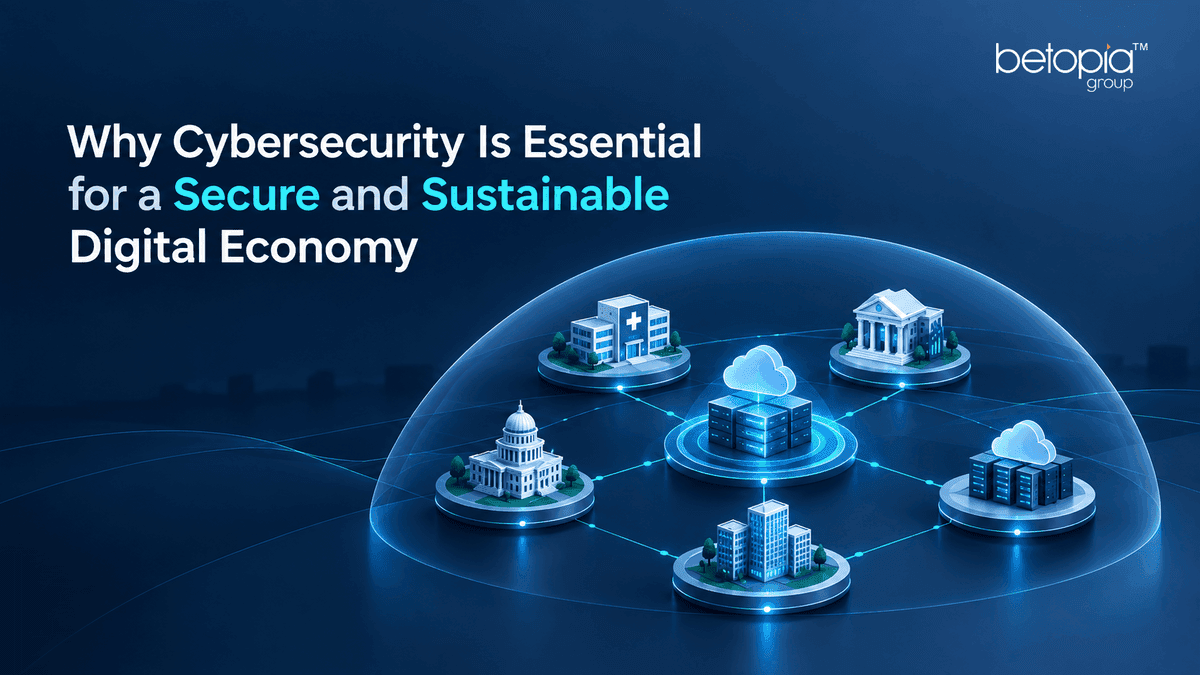
Hospitals use connected diagnostic systems. Banks move money through cloud platforms. Governments deliver services through digital portals. Retailers, manufacturers, and logistics companies run their operations with connected software rather than paper and phone calls. Digital systems have become the backbone of today’s economy.
This raises a clear question: Can a digital economy stay strong if its systems are not trusted, protected, or kept running?
The answer is No. That is why cybersecurity has moved from a background IT task to a top business priority. It is no longer just about stopping viruses or locking passwords.
What Is Cybersecurity?
Cybersecurity is the set of practices, tools, and controls that protect networks, systems, applications, and data from unauthorized access, disruption, or damage. In business, it also protects day-to-day operations, customer trust, and long-term digital growth.
Cybersecurity Is Now a Foundation of the Digital Economy
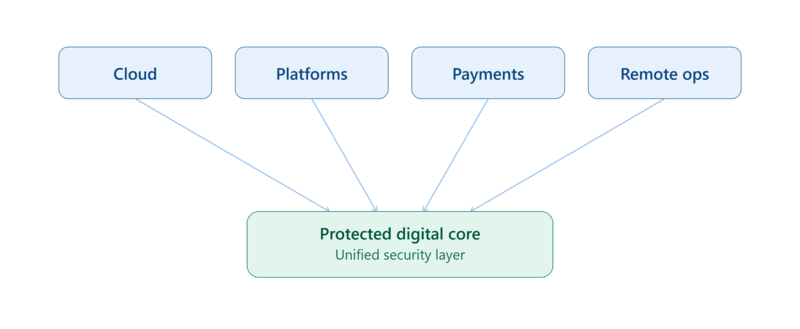
10 years ago, cybersecurity mainly protected a company’s internal network. That boundary has disappeared. Cloud computing, online platforms, digital payments, connected systems, remote work, and data-driven business models have expanded every organization’s digital footprint far beyond its own servers.
These changes bring real benefits: faster service, lower costs, and the ability to reach customers anywhere. At the same time, every new platform, connection, or remote access point creates a possible entry for attackers. Digital growth brings opportunity and risk together.
How Cyber Threats Can Disrupt Digital Infrastructure
Cyber threats are not abstract technical problems. They create real business damage. Common threats include ransomware, phishing, credential attacks, malware, distributed denial-of-service (DDoS) attacks, data breaches, and supply chain attacks that target an organization through a trusted vendor or partner.
A ransomware attack does more than lock files. It can stop order processing, freeze payments, or shut down production. According to the World Economic Forum’s Global Cybersecurity Outlook, ransomware remains the top cyber risk concern for organizations. 72% of surveyed organizations reported higher cyber risks over the past year indicating that disruption, not just data loss, worries leaders most (WEF, 2025).
Verizon’s 2025 Data Breach Investigations Report found ransomware in 44% of confirmed breaches. Stolen credentials were the most common initial means of access, accounting for about 22% of incidents (Verizon, 2025) . Supply-chain and third-party involvement in breaches has also risen sharply. An organization’s risk now includes the security of every partner and vendor connected to its systems.
The costs are high. IBM’s 2025 Cost of a Data Breach Report put the global average cost of a breach at $4.44 million. Breaches took an average of 241 days to identify and contain. Healthcare recorded the highest average breach cost of any industry for the fifteenth consecutive year (IBM, 2025). These figures include lost revenue, regulatory issues, and customer losses.
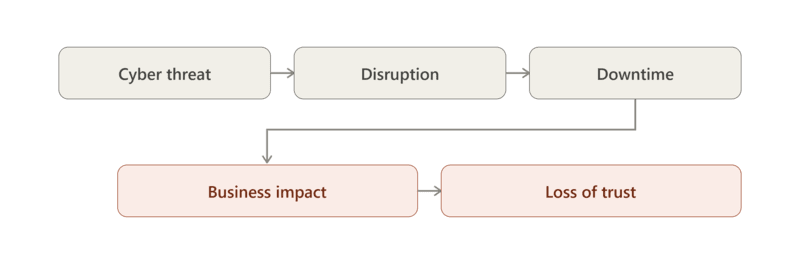
The impact follows a clear path: cyber threat → system disruption → downtime → business harm → loss of trust.
Why Every Digitally Connected Industry Needs Cybersecurity
Financial Services
Banks, insurers, and payment providers depend on trust and speed. A single breach affecting transaction data or account access can lead to regulatory penalties, lost customers, and lasting reputational harm.
Healthcare
Healthcare organizations handle sensitive patient data and connected medical systems. Downtime can affect patient care, not just administration.
Government and Public Services
Public institutions manage citizen data and deliver essential digital services. Disruption damages both convenience and public confidence.
Education
Universities and schools hold large amounts of personal data across research, administration, and learning systems, often with limited security budgets relative to their exposure.
Retail and E-commerce
Online retailers process high volumes of payment data and need constant platform availability. Even short outages during busy periods mean lost sales.
Manufacturing
The integration of operational technology and industrial control systems means a cyber incident can stop physical production lines, not just digital services.
Technology and Professional Services
Firms that handle client data, intellectual property, or infrastructure for others must protect both their own assets and their clients’ digital assets.
What a Modern Cybersecurity Strategy Should Include
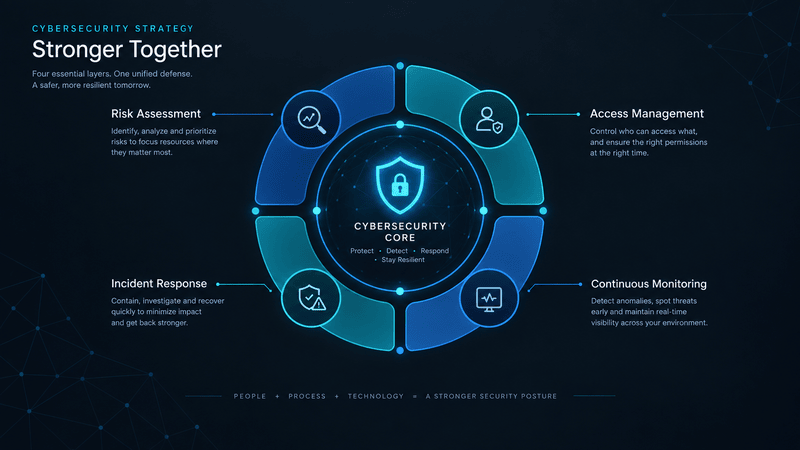
A modern cybersecurity strategy is not a single tool or a one-time checklist. It is a set of connected capabilities that support each other:
- Cybersecurity risk assessment to understand what needs protecting and why
- Vulnerability management to find and fix weaknesses before attackers do
- Network security to control and monitor traffic across systems
- Endpoint security to protect laptops, servers, and devices
- Identity and access management to ensure only the right people and systems reach sensitive resources
- Data protection to safeguard information at rest, in transit, and in use
- Security monitoring and threat detection to spot suspicious activity early
- Incident response to contain and resolve issues quickly
- Security awareness to reduce human error is still one of the most common entry points
- Compliance and governance to align practices with legal, regulatory, and industry rules
None of these works well alone. Strong endpoint security means little if access controls are weak. Advanced monitoring is less useful without a tested incident response plan. The real value comes from how these pieces work together as one system.
How Organizations Can Strengthen Their Cybersecurity Posture
Strengthening cybersecurity is an ongoing process, not a single project. Organizations usually make the most progress by focusing on these practical steps:
- Identify critical assets and systems - know what needs protecting most before deciding how to protect them.
- Assess cybersecurity risks - understand exposure across people, processes, and technology.
- Strengthen access controls - give the right people the right level of access, and no more.
- Monitor threats continuously - visibility enables early detection.
- Regularly assess vulnerabilities - treat this as ongoing work, not a periodic task.
- Prepare and test incident response - a plan that has never been tested is untested when it matters.
- Strengthen backup and recovery capabilities - confirm that recovery actually works, not just that backups exist.
- Assess third-party and supply chain risk - security is only as strong as its weakest connected partner.
- Train employees - human awareness remains one of the most cost-effective defenses.
- Continuously improved security controls - treat every review, incident, and audit as input for the next improvement.
Cybersecurity and Sustainable Digital Development
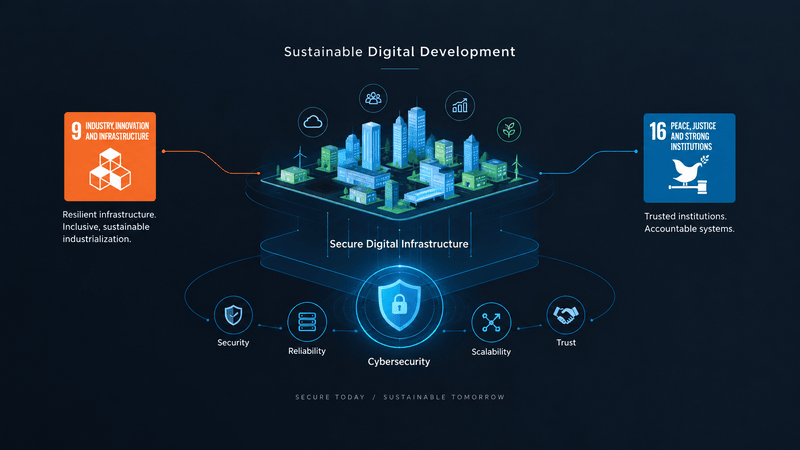
“Sustainable” in digital infrastructure means more than environmental impact. A sustainable digital economy rests on systems that are secure, reliable, resilient, scalable, and trusted over the long term infrastructure that supports growth without constantly adding new risk.
This connects to two United Nations Sustainable Development Goals. SDG 9 (Industry, Innovation and Infrastructure) calls for resilient infrastructure and inclusive, sustainable industrialization both hard to achieve if the digital systems that underpin modern industry are fragile or frequently compromised. SDG 16 (Peace, Justice and Strong Institutions) emphasizes accountable, trusted institutions which, in a digital age, depend on the security and integrity of the systems those institutions use.
Cybersecurity is not separate from sustainable development. It is one of the conditions that enable sustainable digital growth.
Organizations building or strengthening their digital infrastructure should evaluate whether their current cybersecurity capabilities are ready for evolving threats and whether internal resources alone can sustain that readiness over time. Cybersecurity is a strategic foundation that protects digital infrastructure, supports business continuity, builds the digital trust customers and partners expect, and ultimately decides whether digital growth can last.
Betopia’s cybersecurity services are designed to support organizations across this full spectrum, from assessment and monitoring through to incident response and compliance.
The organizations that treat cybersecurity as a shared business priority not just an IT task are the ones best positioned to grow with confidence in an increasingly connected digital economy.